
If you’ve ever owned a turbocharged car, or anything that tows, you’ve probably got an oil cooler under the hood and never thought about it. It’s a small radiator. Hot oil goes through one side, air or coolant goes past the other, and the oil comes out cool enough to go back to the bearings without cooking itself. It’s a cheap, boring part, right up until it cracks, at which point oil ends up somewhere it’s not supposed to be.
A hydroelectric turbine has one too, scaled up to match a machine the size of a house. The difference is what’s on the other side of the metal. In a car it’s air. In a dam it’s the river.
And last month, petroleum ended up in the North Fork Clearwater River in Idaho that way, on September 16, a couple of miles upstream of what the Army Corps of Engineers calls the largest steelhead hatchery in the world.
So what actually happened at Dworshak?
The Corps’ Walla Walla District put out a short statement the next day, and Pullman Radio carried it more or less whole. An oil cooler on the Unit 1 hydropower turbine at Dworshak Dam failed, and petroleum-based bearing lubricating oil got into the river. Project staff found it early that morning, shut the unit down and isolated it from the river so nothing else could get out, then put containment booms and absorbents in the water downstream of the dam.
The notification list is the line I’d read twice. The Corps says it called the National Response Center, state emergency management, the national fish hatchery downstream and the local tribes. That’s the standard list for an oil release into a navigable river, and the hatchery is on it because it pulls its water straight out of the North Fork.
Unit 1 stays shut while the repair gets done, and the Corps is folding it into maintenance that was already on the calendar. Dam operations, in the Corps’ words, remain unaffected, which in plain English means the other two units kept running.
How much oil got out? The Corps hasn’t put a number on it, which is a pretty normal thing for a first-day statement and a slightly less normal thing a month later. We’ll get to that.
The machine behind the oil cooler
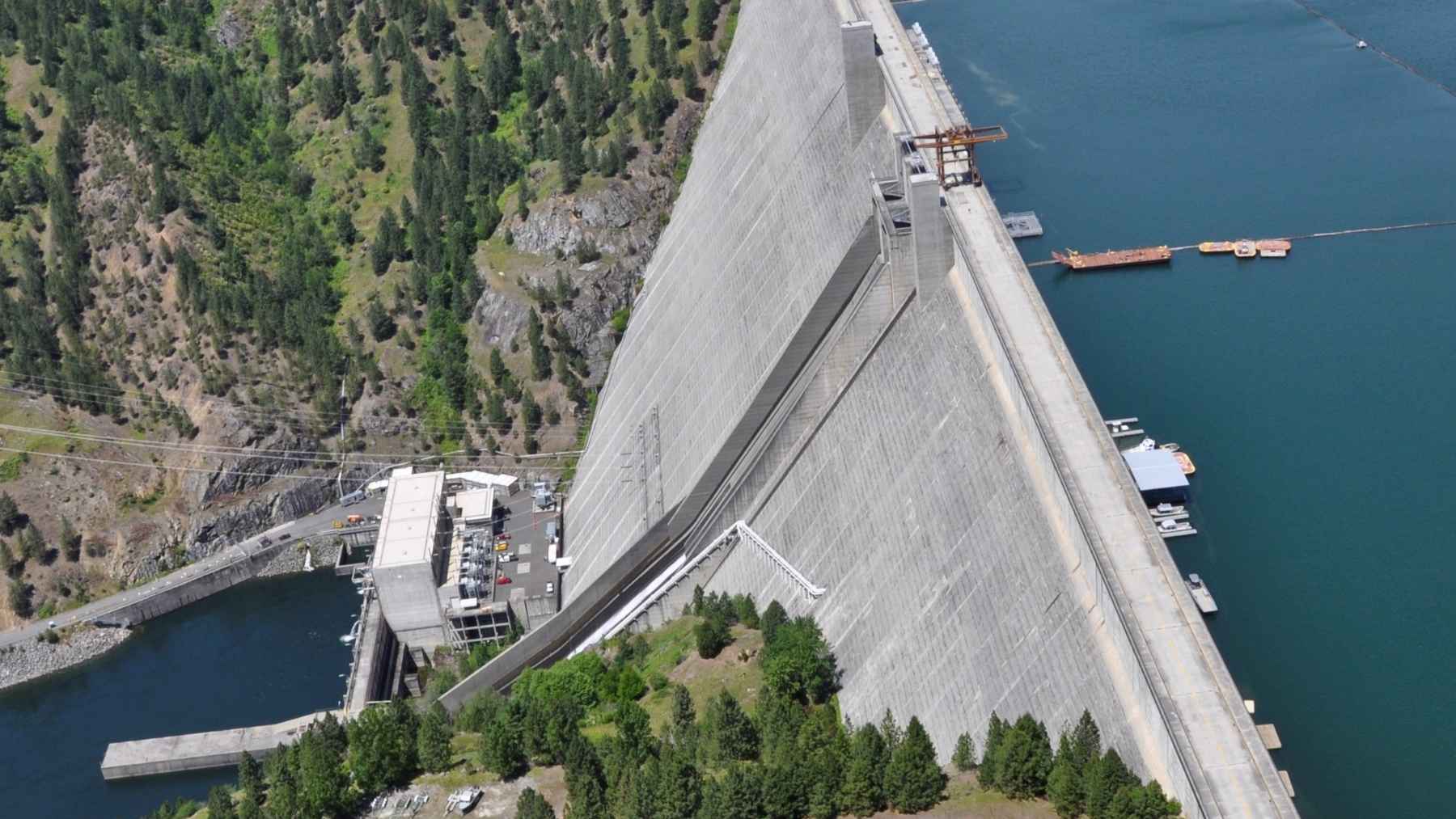
Dworshak sits on the North Fork of the Clearwater River near Orofino, Idaho, and it’s a big piece of concrete. The Corps’ own fact sheet puts the structural height at 717 feet with a crest 3,287 feet long, which makes it the tallest straight-axis concrete dam in the Western Hemisphere. Only two dams in the country are taller: Oroville in California at 770 feet and Hoover at 726. A straight-axis dam doesn’t curve. It’s a wall, well over half a mile wide, holding back a reservoir that runs about 54 miles up into the Bitterroots.
Inside the powerhouse are three generators. Two of them are rated at 90,000 kilowatts apiece, and the third is a 220,000-kilowatt unit the Corps describes as the largest hydroelectric generator in its entire inventory. Add them up and you get 400 megawatts of nameplate capacity.
So which one lost its cooler? Going by the Corps’ numbering and the overhaul history, Unit 1 is one of the 90-megawatt pair. The 220-megawatt machine is Unit 3, and that one spent the better part of two years torn apart for a rewind a while back. Nobody at the Corps has said that in so many words this time around, but every record I can find points the same way.
Which means Dworshak is down about 22 percent of its capacity for the duration, not 55. That’s a meaningful difference if you’re the Bonneville Power Administration selling the output, and a fairly small one if you’re a fish.
What an oil cooler is doing inside a dam
A turbine generator at this scale spins on bearings that live in a bath of oil, and the shaft puts a lot of heat into that oil. So the oil gets pumped through a heat exchanger. On a dam, the cheapest cooling medium in the world is sitting right outside, so the exchanger runs river water through one side and bearing oil through the other, separated by tube walls.
Now picture one of those tubes cracking. Oil pressure on one side, water on the other, and the water side drains back into the tailrace. You don’t need a dramatic failure for that to turn into a sheen on the river. You need a pinhole and a few hours.
I’m describing the general layout here, not the specific hardware in Unit 1. The Corps hasn’t published a failure analysis, and I don’t expect one in a press release.
It has said something useful in another context, though. When the EPA was writing Dworshak’s discharge permit, the Corps told the agency its people check the outfalls for oil sheens every day and report anything they see to the National Response Center. Early-morning discovery fits that routine pretty neatly. Somebody walked out, looked at the water, and saw it.
So what’s downstream?
Dworshak is 717 feet tall, and you can’t build a fish ladder up 717 feet of concrete at any price anyone would pay. Getting fish past a dam is a hardware problem, and we’ve covered a lab that reshaped turbine blades so sturgeon come out alive, but nothing like that was on the table when Dworshak was built. So when the dam went in, the steelhead run up the North Fork ended, and the Corps built a hatchery at the confluence to replace it. The U.S. Fish and Wildlife Service and the Nez Perce Tribe run it together now, and it turns out millions of steelhead, Chinook and coho a year. The Corps calls it the largest steelhead hatchery in the world.
Its water comes from the North Fork. Not from a well, not from a separate intake above the dam. From the river the oil went into, a couple of miles below the outlet.
That’s why the hatchery is on the Corps’ notification list, and frankly it’s why this story is a story. An oil sheen on a mountain river is unpleasant. An oil sheen pulled into raceways holding the next several years of a steelhead run is a different category of problem.
Has that happened at Dworshak before? Twice in the last ten years, as far as I can find, and both times the fish came through. A decade ago a contractor overhauling Unit 3 released about 290 gallons of light turbine oil, and the Corps said only a fraction reached the river. Last year a hydraulic leak from the hatchery’s own small power plant, the one on its water supply pipe, put an estimated 4.6 gallons into the raceways and the North Fork. State water officials said the raceways held more than 8 million juvenile salmon and steelhead at the time and that no fish died.
Neither the Corps nor the hatchery has reported any dead fish from the September 16 release either, and I’d have expected that to surface by now if there were any. Still, I’d like to see the hatchery say so directly, and I haven’t found that yet.
The permit says the oil wasn’t supposed to be petroleum, probably
Here’s where it gets a little more interesting than a cracked tube.
Dworshak has been in court over oil before. In 2021 a group called Snake River Waterkeeper sued the Corps in federal court in Idaho, arguing the dam was discharging oil and grease into the river without a Clean Water Act permit. The two sides settled that September with no admission of anything. The Corps agreed to push its pending permit application through, to tell Waterkeeper about every spill it reported to the National Response Center until the permit came through, to assess whether its underwater grease could be swapped for biodegradable lubricants or dry parts, and to post annual accounting of every gallon of oil and grease delivered to the dam for its in-water parts.
The permit itself came through in 2023. The EPA’s response to comments on it says, in one line, that the permit requires the use of environmentally acceptable lubricants for all equipment with oil-to-water interfaces. The fact sheet adds the words “unless technically infeasible.”
A bearing oil cooler, where oil and river water sit on opposite sides of a tube wall, is about as literal an oil-to-water interface as you’ll find in a powerhouse. And the Corps described what came out of Unit 1 as petroleum-based.
Does that mean somebody broke the rules? I don’t know, and nobody has said so. It’s entirely possible the Corps assessed the main unit bearings and filed them under infeasible, which the permit allows. The annual lubricant reports that would answer the question stay on site at the dam, available to the EPA and the Nez Perce Tribe on request, which means they’re not something you or I can pull up. So I’ll leave it there, as a question a reporter in Idaho could probably get answered with one phone call.
What I will say is that the dam’s defenses were built for a different kind of leak. Dworshak has an oil-water separator in its drainage sump that the Corps says would never let oil out of the building. It has daily sheen checks. It has a spill plan and annual drills. And a cracked cooler on the river-water side of a turbine goes around all of it, because that oil never reaches the sump. It goes out with the cooling water.
Where things stand
Against the month hydro has had, with a 142-megawatt plant in Tasmania burned to its frame, one cracked oil cooler is a small story, and I’d argue the response was about as good as you’d want: found early, shut fast, boomed the same day, hatchery and tribes called before the public was.
I’d still like the number. A first-day statement without a gallon figure is fine. A month without one, on a river that feeds the largest steelhead hatchery in the world, with a permit that requires sheen reporting, is a bit of a gap. I’d expect it to get filled.
As of the Corps’ last public word on it, September 17, Unit 1 at Dworshak is still out of service and isolated from the river, with the repair rolled into maintenance that was already scheduled, and the dam’s other 310 megawatts are still spinning.