
Used coffee grounds don’t get much respect. They come out of the espresso machine as a damp brown puck, get knocked into a bin, and in Australia most of them end up in a landfill. RMIT University says the country throws out about 82,700 tons of them a year.
But a team of engineers at RMIT in Melbourne has spent the last few years turning that sludge into something you can pour. It’s already in two sidewalks in the state of Victoria, and one of them sits along a busy road outside the city.
Concrete is basically cement, water, sand and gravel. The cement is the glue, and the sand and gravel give it bulk. What RMIT does is pull out some of that sand and put cooked coffee in its place.
And yes, cooked is the right word. The team heats the grounds to about 662 degrees Fahrenheit with no oxygen around, a process called pyrolysis. Take the oxygen away and nothing can burn, so the grounds slowly turn to char, which is pretty much how charcoal gets made from wood. What’s left is biochar, a fine, carbon-rich powder that’s grainy enough to stand in for part of the sand.
So why not skip the oven and dump the grounds straight into the mix?
Because raw coffee is loaded with organic compounds. They leach out into the wet concrete and get in the way of the chemical reaction that makes cement harden, and RMIT’s lab work found untreated grounds made the concrete a lot weaker. Charring them first fixes that, at least if you get the temperature right.
The 30% figure is a lab number
In the original RMIT study, published in the Journal of Cleaner Production, the team tried biochar baked at two temperatures, 662 and 932 degrees. The cooler batch won. Swapping 15% of the sand for it gave a 29.3% jump in compressive strength, and that’s where the “30% stronger” line you may have seen comes from.
Compressive strength is how hard you can squeeze a sample before it cracks. Engineers usually cast concrete cylinders, let them cure for 28 days and then crush them in a press, and RMIT says its roughly 30% gain is a 28-day result. So it’s the same kind of test a contractor would look at before signing off on a mix.
Still, a cylinder in a lab isn’t a sidewalk. That’s where it gets a bit messier.
Gisborne’s sidewalk didn’t get the boost
RMIT’s first real pour went into a footpath (that’s Australian for sidewalk) in Gisborne, a town northwest of Melbourne, with the Macedon Ranges Shire Council. RMIT calls it a world first. The path was split into three panels: one with coffee biochar, one with biochar made from wood chips, and one of plain concrete to compare against.
Shane Walden, the council’s director of assets and operations, said residents “aren’t going to really see or smell any difference.” Which is good news if you were worried about your walk to work smelling like a coffee shop.
Here’s the catch, though. RMIT has said supply chain issues kept it from using biochar from its own low-energy process in Gisborne, and that concrete came out about as strong as regular concrete. That’s a pretty candid thing for a university to put in its own press release, and frankly I respect it. The trial also kept the normal amount of cement, so it didn’t test RMIT’s other claim, which is that the biochar could let builders cut cement by as much as 10%, based on the team’s earlier work, according to RMIT’s release on the Gisborne trial. The researchers said they planned to try a lower-cement version later.
I’d argue that cement number is the more interesting one. Making cement means heating limestone and clay to around 2,700 degrees, and that step is where most of concrete’s carbon footprint comes from. As far as I can tell, RMIT hasn’t published a field result for a lower-cement coffee mix yet.
Pakenham got the bigger pour
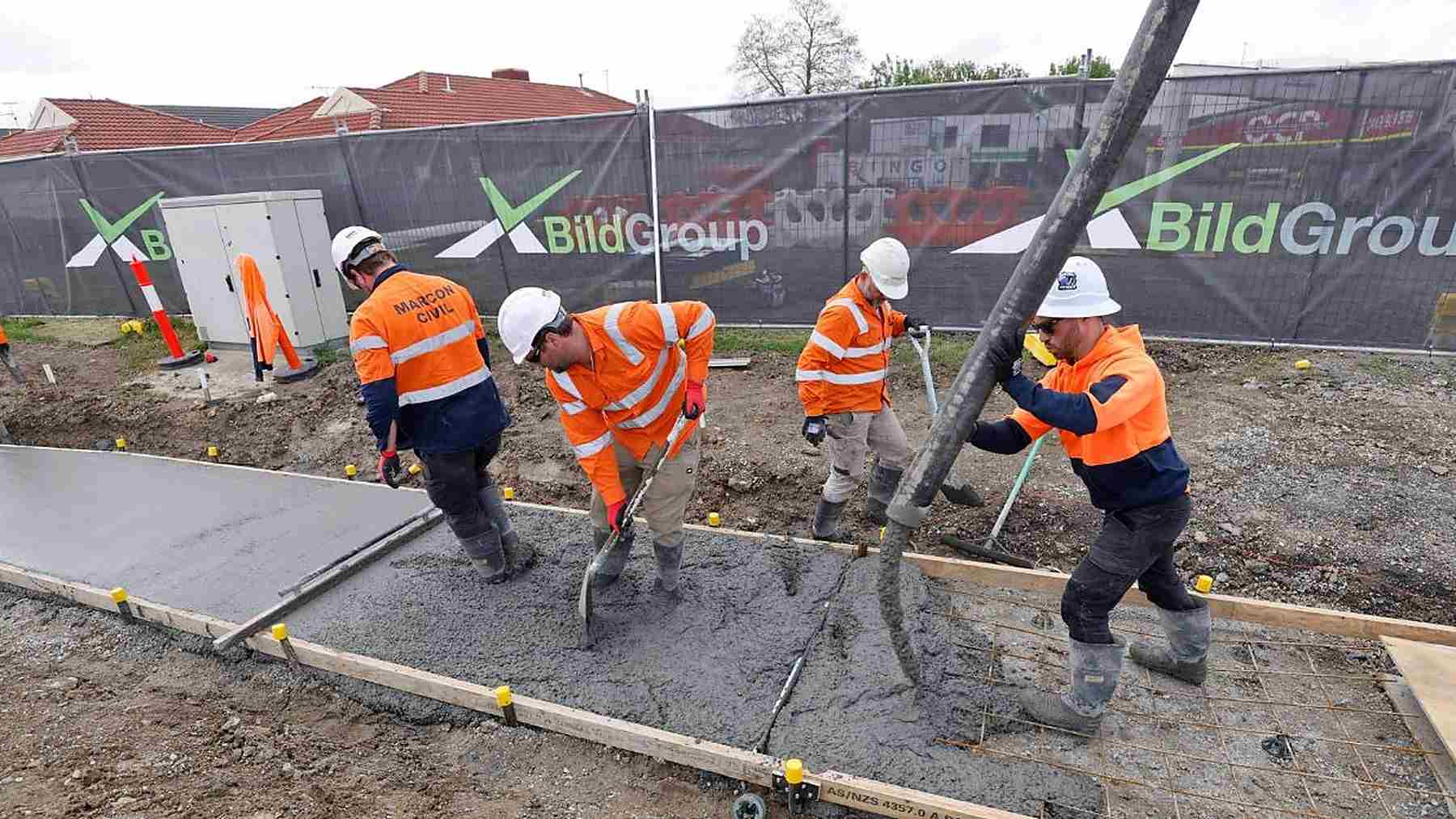
The second sidewalk is a step up. Major Road Projects Victoria and its contractor, BildGroup, laid 39 cubic yards of coffee concrete along McGregor Road in Pakenham, on Melbourne’s southeastern edge, as part of the Pakenham Roads Upgrade. It was the first project in Victoria’s Big Build, the state’s big umbrella of road and rail work, to use the stuff.
To make it, a company called Earth Systems took 5.5 tons of spent grounds, about 140,000 cups’ worth, and turned them into 2.2 tons of biochar, according to RMIT’s release on the Pakenham job. BildGroup CEO Stephen Hill said it saved more than 3.3 tons of sand.
If you’re wondering how 5.5 tons of grounds shrinks to 2.2 tons, wet grounds are heavy. Most of what disappears is water and other stuff that cooks off in the oven, which is basically what happens to anything you char.
What I couldn’t find is a strength figure for the Pakenham concrete. RMIT’s release doesn’t give one, and it doesn’t say whether Earth Systems used the same low-energy process from the lab. So I can’t tell you this sidewalk is 30% stronger than regular concrete. It might be. We don’t know yet.
A 39-cubic-yard sidewalk is a fairly modest test for a road program that size. But it’s real concrete next to real traffic, which is probably more than most lab recipes ever get.
Less sand also means less carbon
Then there’s the carbon side. A newer RMIT study in the International Journal of Construction Management ran a cradle-to-grave life-cycle analysis on coffee-biochar concrete. Basically, that means adding up the emissions and resources from making the materials all the way to the day the concrete gets torn out, instead of counting only the pour.
The more biochar went in, the bigger the cut. Here’s how it broke down, according to RMIT’s summary of the study:
Dr. Jingxuan Zhang, one of the lead researchers, was careful to say the savings held in the scenarios the team assessed, which is a fair hedge for a model. Still, it’s a pretty tidy result. The 15% mix that cuts the most carbon is also the one that tested strongest in the lab.
Sand is arguably the sleeper issue in all this. RMIT says construction uses about 55 billion tons of natural sand a year worldwide, mostly scooped out of rivers, and the supply isn’t endless. You can’t just swap in desert sand either, something we got into with Saudi Arabia’s sand problem: wind-worn grains are too round to lock together well in concrete.
Keeping grounds out of the dump helps too. RMIT says organic waste sent to landfill, coffee included, accounts for 3% of Australia’s greenhouse gas emissions, and grounds give off methane as they rot.
At one point, RMIT told Reuters it was talking with construction firms, concrete makers and Starbucks about taking their used grounds. Starbucks didn’t comment, and I haven’t found anything public since that says a deal happened.
RMIT has said it’s working with a commercialization partner and talking to construction and farming companies that could use biochar. Dr. Mohammad Saberian, another lead researcher on the carbon study, says the next step is bigger pilots, a fine-tuned mix and lining the recipe up with building standards, so projects can sign off on it with confidence.